With the launch of our new website, we have integrated our blog with our company website. You can continue to follow our blog at http://www.i8c.be/blog/. New blog entries will be posted on our new blog only. New entries will no longer be posted on Blogger.
Enjoy
Thursday, April 9, 2015

Tuesday, February 24, 2015
IBM InterConnect: The Premier Cloud Computing & Mobile Conference
Sunday I arrived at IBM Interconnect 2015.
IBM has decided to combine the 3 conferences – Impact, Pulse and Innovate into
one Conference. IBM Interconnect- The Premier Cloud Computing & Mobile
Conference. It started Sunday with the Business Partner Summit.
Monday the
real conference started. There was a big American style opening session.
If you want more information about it just look at #ibminterconnect on twitter
or countless other blogs. As an integration consultant, I mainly focus on
products like IBM Integration Bus, IBM MQ, Datapower, API management and BPM.
I attended
some great sessions on Monday about what is new in the products. I will now
give a short overview about what’s new. When I have time I will write an
article to go deeper into the different products seperatly. I will now just give the key features I
found most interesting.
IBM Integration bus
Last year the Open beta was announced, this year the
official release is announced.
- Platform support is extended.
- Most important for me: The developer experience has improved. They did it by simplifying the installation, introducing the concept of a policy, some nodes are now replaced with connectors. There is also a connector framework available to create your own connectors in a simplified way.
- The data and transformation capabilities has been improved.
- The way IIB is connected with IBM MQ. IBM MQ is no longer a required prerequisites. You can run IIB without IBM MQ. On the other side IIB can now be connected to multiple Queue Managers and different Integration Node scan connect to the same Queue Manager. When you want to use 2phase commits (and who doesn’t want this ? ) you still need MQ as a transaction manager. The speaker said that they are planning on opening IIB so other transaction managers can be used.
Datapower
Nothing new was introduced since the 7.1 release in November 2014. To recap the 7.1 release:- IBM renamed it to IBM Datapower SOA Appliance
- There is now only one singular, modular and extensible platform. You no longer have the distinction between the XG, XI and XB systems. There is only one and you can extend it with different modules
- B2B Module
- Tibco EMS Module
- Integration Module
- Application Optimization Module
- ISAM Proxy Module
IBM MQ Family
- In this family I had my biggest surprise. There was the announcement of an IBM MQ Appliance. The release date will be 13 march 2015. It is ideal to use as a messaging hub or to extend MQ connectivity to remote locations. The appliance can run different MQ V8 queue managers. There are some restrictons. More information can be found on http://ibm.biz/mqappliance
- Fix pack 2 is being released somewhere next week. The most interesting change is the authentication. You can now use ldap to authenticate with an LDAP. The queue manager has to run on a Linux or Unix. This authentication will also be available on Windows in the near future. There is also a new concept of a “routed” topic. Basically you have some queue manager who know everything and connect with everyone. This way the traffic for pub/sub can minimized.
- IBM is adding in support for MQ Light into the IBM MQ product. A new AMQP 1.0 channel will be available that can be used to connect an MQ light application with a IBM MQ V8 queue manager. A tech preview is available for fix pack 2.
- MQ Light is also available in BlueMix.
- IBM MQ Adavanced for developers has been released.
Author: Jef Jansen
Wednesday, January 7, 2015
IBM BPM – Task Notification Email template
A customer of mine had the requirement to send an email every time a task is created for a user. Rather than polluting our process with an email activity we decided to use the built in functionality IBM BPM provides. When a user logs in into Process Portal she/he can set some preferences. One of them is to send an email when a new task arrives for the user (or his group).
Friday, January 2, 2015
Devops (3): Chef (and some fun cooking)
After having looked into Vagrant, it became clear that Puppet and Chef are "the" tools to do the structured and repeatable configuration of machines. I picked the recent book "Learning Chef" to learn and experiment a bit.
 Tools
Tools
Note: the tool Ansible does the opposite, pushing configuration data to the machines.
Many cookbooks or recipes can be downloaded from the Chef Supermarket and others.
Finally
After spending some time look around in the world of DevOps and its tools, I have a few general Observations:
- The book uses the recent Chef Development Kit which should gradually replace the tool called Knife.
- The tool "Chef" uses the the Recipe DSL to write recipes (Domain Specific Language, based on the Ruby programming language)
- VirtualBox is used for running the VM's that are going to be cooked and baked
- Complemented with our good friend Vagrant (see previous DevOps blog)(actually kitchen-vagrant)
- Finally the tool kitchen is used
Note: the tool Ansible does the opposite, pushing configuration data to the machines.
Many cookbooks or recipes can be downloaded from the Chef Supermarket and others.
Finally
After spending some time look around in the world of DevOps and its tools, I have a few general Observations:
- Devops is strongly focused on Linux
- Diverse programming languages such as Ruby and Erlang are used
- This is a domain in full flux, new initiatives and companies pop up, things evolve rapidly
- First time I see the file format YAML actually being used
Author: Guy
Wednesday, December 31, 2014
Devops (2): Vagrant
 After looking a bit into Docker, I went on to look into Vagrant, another well-known tool to provision and configure virtual machines.
To learn about Vagrant, I read the book "Vagrant: Up and Running". This O'Reilly book is well-written and the examples all work. While doing the exercises on a Windows Server 2012R2 VM, I hardly encountered any problems. Starting the Ubuntu VM with the vagrant up command and removing it with vagrant destory.

The Vagrant command line tool allows to create a Virtual Machine in a reproducible and neutral manner. Vagrant was initially developed around the the free VM product Oracle VirtualBox. But Vagrant now comes with many other providers, e.g. AWS, Rackspace, IBM SoftLayer and Microsoft Azure. Support for VMWare however is not free ($79).
Vagrant focuses on the creation of Virtual Machines in a neutral manner. Contrary to Docker, it uses an actual Virtualization solution to provision the virtual machines. This allows Vagrant to support multiple Operating Systems in parallel. And offers support for automating the creation of Windows based virtual machines.
When Vagrant is used in combination with Oracle VirtualBox, Vagrant will use the VBoxManage.exe of VirtualBox. To create machines with a cloud provider, the respective Vagrant provider will leverage the API and tools of the specific Infrastructure-As-A-Service solution. Vagrant configure all sorts of attributes of the virtual machine, incl. e.g. networking (and port forwarding).
For the actual provisioning of the machines, Vagrant supports many options, including command line. But most often, Vagrant will be used in combination with Chef or Puppet. E.g. the Chef development kit uses Vagrant as its default "driver".
Boxes
Vagrant does not start from an ISO image, but from an already prepared "box". The more such box is pre-configured, the fewer configuration needs to be done afterwards. Vagrant uses its own software format to package the virtual machines that are taken as a starting point (compare to Amazon Machine Images). Vagrantbox.es and many others make pre-packaged Vagrant boxes available.
Windows specific
- VagrantManager makes Vagrant accessible from the Windows (or iOS) Taskbar
- The company modern.IE makes Windows boxes with all sorts of IE versions available.
- Interesting blog on how to create Variant Windows boxes
- Vagrant can directly access the command line of Linux boxes over SSH (secure shell). For Windows boxes this cal also be arranged wen cygwin (or other SSH server) is installed. But Vagrant can also use WinRM to access the Windows command line
- Where the installation of software on Linux boxes leverages apt-get or yum to install software packages, Chocolatery wants to bring a similar solution to the Microsoft world; many packages are available for quick and easy installation
- Boxstarter leverages Chocolatey packages to automate the installation of software and create repeatable, scripted Windows environments.
In my own domain of Application Integration and SOA, I expect that both vendors and customers will pickup tools such as Vagrant for creating and provisioning (virtual) machines. Combined with Chef or Puppet to actually install and configure the software on these machines.
Author: Guy
Monday, December 29, 2014
Devops and Docker
The holiday period between Christmas and New Year is an ideal period to catch up on some reading and experimenting. Devops and tools such as Docker, Vagrant, Chef, Puppet and Ansible were on my radar for a while. So finally some time to dive into this topics.
Nested VMs
Not to mess up my machine, I use VMWare workstation to spin up some test machines. As these Devops tools are all about creating and provisioning virtual machines, one must enable "Nested VMs" support. This allows one virtual machine to run in another.

Docker

Docker appeared on my radar while learning about Micro Services. Docker focuses on the creation of light-weight containers in which applications are configured in an automated manner.

The Linux Containers are very small by leveraging OS level virtualization of Linux. Is it some "chroot on rocks". The chroot system call on Unix/Linux changes the root directory for a program and all of its children. chroot allows programs - e.g. a web server - to run in a more protected mode. The OS level virtualization can limit all the resources used by child processes: CPU, memory, disk space, ... Because containers are so light-weight, many of them can be run on a single machine. This mechanism allows each application to run in its own container, its own virtualized OS.
To have a quick try of Docker, there is a great Online Tutorial consisting of 10 steps. Recommended!
As there aren't any books available on Docker, I watched the brand new training material of LiveLessons. As I couldn't find the text material, had to type over the instructions from the paused video. After wasting some time trying to get access the Fedora Atomic container on the Fedora 21 host, decided to switch to another topic, Vagrant. If I have some more time, I'll come back and retry with RHEL as used in the video training. Or switch to Windows and take a look boot2docker.
Author: Guy
Nested VMs
Not to mess up my machine, I use VMWare workstation to spin up some test machines. As these Devops tools are all about creating and provisioning virtual machines, one must enable "Nested VMs" support. This allows one virtual machine to run in another.
Docker
Docker appeared on my radar while learning about Micro Services. Docker focuses on the creation of light-weight containers in which applications are configured in an automated manner.
The Linux Containers are very small by leveraging OS level virtualization of Linux. Is it some "chroot on rocks". The chroot system call on Unix/Linux changes the root directory for a program and all of its children. chroot allows programs - e.g. a web server - to run in a more protected mode. The OS level virtualization can limit all the resources used by child processes: CPU, memory, disk space, ... Because containers are so light-weight, many of them can be run on a single machine. This mechanism allows each application to run in its own container, its own virtualized OS.
To have a quick try of Docker, there is a great Online Tutorial consisting of 10 steps. Recommended!
As there aren't any books available on Docker, I watched the brand new training material of LiveLessons. As I couldn't find the text material, had to type over the instructions from the paused video. After wasting some time trying to get access the Fedora Atomic container on the Fedora 21 host, decided to switch to another topic, Vagrant. If I have some more time, I'll come back and retry with RHEL as used in the video training. Or switch to Windows and take a look boot2docker.
Author: Guy
Thursday, December 11, 2014
Datapower XQuery replace
One of the
clients that I’m working for discovered a problem with a SOAP web service querying an LDAP. The
service could contain a ‘*’ in plain text in possibly different fields in the
message. When the service is called it uses the ‘*’ as a wildcard. The system
should handle the ‘*’ as plain text so we need to escape the character with ‘\2a’
(escape for a LDAP filter query). So they looked in complete web service chain
where the least impact was. They decided that an update in the DataPower configuration
was the best option.
This is a
small message example, but the ‘*’ can occur in couple different WSDL operations and in different fields.
<soap:Envelope xmlns:soap="http://www.w3.org/2003/05/soap-envelope"
xmlns:tem="http://tempuri.org/">
xmlns:tem="http://tempuri.org/">
<soap:Header/>
<soap:Body>
<tem:FindUser>
<tem:UserName>KMe_*</tem:UserName>
</tem:FindUser>
</soap:Body>
</soap:Envelope>
I immediately thought to use the function str:replace(). But unfortunately it is not supported in Datapower, which brought me to XQuery, as an alternative for XSLT. So this is the solution that I developed.
Because the replacement is only
necessary for 3 operations from the WSDL I defined the policy-rule on WSDL operation level.

Below the XQuery code used to
replace the ‘*’ into ‘\2’a. The XQuery can be extended to handle other values
that need to be escaped for example: ( )
\ / NUL
xquery version "1.0";
declare namespace local = "http://example.org";
declare function
local:copy-replace($element as element()) {
element {node-name($element)}
{$element/@*,
for $child in $element/node()
return if ($child instance of element())
then
local:copy-replace($child)
else replace($child,'\*','\\2a')
}
};
local:copy-replace(/*)
The total number of requests that have a ‘*’
or other wildcards in the username is limited. To improve the
performance I adapted the standard SQL-injection filter to search for ‘*’ and
output the number of hits. This way when the hit count is 0 I can skip the
XQuery transform action.
Author: Kim
Thursday, November 27, 2014
SAP PI to Oracle with batch insert - Improved performance
We were
implementing a bulk-data transfer from SAP into an Oracle database. Easily
upwards of 15 000 materials were being uploaded to the database via a
stored procedure (company policy). Normally we like this approach because it
decouples PI from the database’s underlying table structure, but we were
getting terrible performance.
In testing,
the entire workflow took almost 2 hours. Whilst this in itself wasn’t an issue
(the process runs in the middle of the night), it was unnecessary load on both
systems, and the extended duration put the process at increased risk of failure
(e.g. due to network issues).
Keen to
improve this, we looked at PI’s “batch insert” capabilities. In order to
maintain the decoupling, and in order to protect the destination tables, we
created an interface table to temporarily contain the material data, and a
procedure that safely updated the destination table.
Testing
showed a 30-to-60-fold performance improvement during the PI-DB exchange, and
the entire process ended up taking just 10 minutes.
Author: Edwin
Thursday, November 20, 2014
ESB = Erroneous Spaghetti Box?
While re-reading the Microservices article by Martin Fowler, I was triggered by the following footnote #7: We can't resist mentioning Jim Webber's statement that ESB
stands for "Egregious
Spaghetti Box". I viewed the presentation - from 2008 -
in which Jim Webber and Martin Fowler bash the Enterprise Service Bus
and translate the acronym ESB into Erroneous Spaghetti Box.

I do agree that often, the integration platform simply contains a spaghetti of point-2-point integrations. But that's good! Way better than all that integration logic dispersed over many systems. With a wide variety of integration techniques, protocols and message formats. And spaghetti in a box is exactly what I tell when explaining what an integration platform is. Only by taking the next step of careful service and message design, one can arrive at a true Service Oriented Architecture.
Let's sum up the main advantages of an integration platform:
Author: Guy
I do agree that often, the integration platform simply contains a spaghetti of point-2-point integrations. But that's good! Way better than all that integration logic dispersed over many systems. With a wide variety of integration techniques, protocols and message formats. And spaghetti in a box is exactly what I tell when explaining what an integration platform is. Only by taking the next step of careful service and message design, one can arrive at a true Service Oriented Architecture.
Let's sum up the main advantages of an integration platform:
- A standardized way to have applications talk to one another
- No coding in a 3GL such as Java or C# but configuration in an application specifically built for the task of integrating systems
- Support for applications of different kinds and ages, including packaged applications
- Strongly reduced diversity in the tools and techniques used to integrate applications
- Support for reliable, asynchronous communication using queuing and message persistence (which Fowler doesn't seem to like either)
- Trivial connectivity through adapters
- Central place to monitor and manage the communication between systems, in particular the reliable message exchange
- Help turn packaged or older applications into services if desired (not everything is developed in-house)
- That it is a central, separate platform,
- Requiring some specific skills (XML)
- The cost of the integration development and support becoming truly visible.
Author: Guy
Thursday, November 13, 2014
Micro Services - Conway Law and Application Integration teams
"Micro Services" is a new buzzword in world of IT architects. As it talks about application components communicating over a network and contains "services", it probably has something to do with SOA and integration. So I had to look into it.
Let's bulletize the description from the article by Martin Fowler and James Lewis:
Conway law - Integration Competence Center
But there was one aspect that triggered me in particular when learning about Microservices: Conway Law: "any organization that designs a system (defined broadly) will produce a design whose structure is a copy of the organization's communication structure".
So this law states that an application architecture will reflect the way an IT department is organized. Microservices advocates refer a lot to it.
For Microservices to focus and align with business functionality, the teams developing (and maintaining) the Microservices should therefore be cross-functional, including the full range of skills required for the development: user-experience, database, and project management.
Orthogonal to the view of the Microservices architects, that Conway Law confirms my personal view and opinion that any IT organization that wishes to leverage a central integration platform to a great extent, requires a separate team developing on and managing that integration platform.
How did I learn about MicroServices?
PS: when searching for the term "micro service", I found the term also in the book "Java Web Services Architecture" back from 2003!
Author: Guy
Let's bulletize the description from the article by Martin Fowler and James Lewis:
- The Microservices architectural style is an approach to
- developing a single application < application architecture
- as a suite of small services, < componentization, no libraries
- each (service) running in its own process
- and communicating with lightweight mechanisms, < over the network
- often an HTTP resource API. < REST, message bus
- These services are built around business capabilities < Domain Driven Design
- and independently deployable by fully automated deployment machinery.
- There is a bare minimum of centralized management of these services,
- which may be written in different programming languages and
- use different data storage technologies < eventual consistency
Conway law - Integration Competence Center
But there was one aspect that triggered me in particular when learning about Microservices: Conway Law: "any organization that designs a system (defined broadly) will produce a design whose structure is a copy of the organization's communication structure".
So this law states that an application architecture will reflect the way an IT department is organized. Microservices advocates refer a lot to it.
 |
| Service boundaries reinforced by team boundaries (picture from article by Martin Fowler) |
For Microservices to focus and align with business functionality, the teams developing (and maintaining) the Microservices should therefore be cross-functional, including the full range of skills required for the development: user-experience, database, and project management.
Orthogonal to the view of the Microservices architects, that Conway Law confirms my personal view and opinion that any IT organization that wishes to leverage a central integration platform to a great extent, requires a separate team developing on and managing that integration platform.
How did I learn about MicroServices?
- The Microservices article by Martin Fowler and James Lewis
- Rough cut version of the O'Reilly book "Building Microservices" by Sam Newman
- Software Engineering Radio podcast episode with Stefan Tilkov
- Software Engineering Radio podcast with James Lewis
- SAI evening session I attended with great presentation by Stijn van den Enden and colleagues

PS: when searching for the term "micro service", I found the term also in the book "Java Web Services Architecture" back from 2003!
Author: Guy
Thursday, November 6, 2014
Message modeling and XSD generation
As an
integration consultant I work almost daily with XML messages. In my opinion in
order to work efficiently with XML you need to have XML schemas. XML schemas
makes it possible to validate your messages (including those hard to find
typo’s in mappings), they can be used to generate documentation, they define
your service contracts and can be used to generate a skeleton of your code. if and when
validation should be enabled is a different discussion. Perhaps in the future I
will write another article about it.
In order to
benefit from XML schemas they need to be clear, precise, flexible and
interoperable with the different technologies you are going to use on your
project. Amongst us colleagues we regularly have lively discussions on how to
achieve this. We all have the same ideas on the general guidelines but sometime
we disagree about some details. Mostly it boils down to the choice of
technology we are used of working with. But I am relatively sure I can work
with the schemas created by my peers.
One major
downside of XML schemas is that it is very technical and functional analyst
don’t always understand it very well and why should they? They want to model
the messages in their favorite modelling tool. In the perfect world you can
generate the XSD’s from the model. This way you can enforce the policy you have
defined to which the XSD’s should conform.
So what is
wrong with this? Nothing! I even encourage you to do it. If it is done
correctly and you keep in mind that in the end a developer has to import the
XSD’s in his tool and work with them.
On a recent
project I had to import an XSD from a third party in order to interact with them. In their documentation they were very proud of their UML model and
how clever they were modelling there data. With the generated XSD they were less
concerned. From what the XSD should be: simple, flexible, easy to understand …
nothing was achieved. I spend 2 days trying to import them in my tool (IBM
Integration Toolkit). In the end I gave up as I could no longer justify the
time spent to my client. I wrote my own
(very simple) XSD’s that conform to the messages we need to send and receive
and used those within our tools.
For those
thinking: then don’t use IBM Integration toolkit. I have quite some experience
with IBM tooling and in my career I never before had so much problems importing
XSD’s. I find the XML support of IBM tools excellent. We tried to import the
XSD’s in different tools and they all failed.
So to
conclude I want to give you some advice:
- Pay attention to your XML Schemas
- Define guidelines/rules to which you XML schemas should adhere within your organization
- For a public interface make sure the XML schema does not use too advanced schema features (UN/CEFACT Naming and Design Rules may help you there)
- Model your data and generate the XML Schemas from the (UML) model but let your developers validate the generated XSD’s
XML Schemas should be an aid not a burden ! Keep it Simple !
Author: Jef Jansen
Thursday, October 30, 2014
Websphere Technical University Düsseldorf 2014 - Part 2
I started day 2 of the WTU conference with a session from Michael Hamann about some of the new features in IBM Websphere Datapower (V7) concerning the Datapower Policy Framework and Service Patterns.
The Datapower policy framework is managed on Websphere Service Registry and Repository and enforced on Datapower. This setup isn’t new, but already exists since Datapower firmware version 5.0.0. What’s new since version 7 is the possibility to use variables in the policy-config, this feature is called dynamic policy variability.
Another new feature in V7 is Service Patterns, these are templates that you can create from existing services in a new GUI, the Blueprint Console.
I experienced myself that many of our customers already created their own scripts to work with some sort of templates for the common integration scenarios, so the use of service patterns will be great for them. They will have a supported way of working that brings more features than what they have right now.
Of course not all sessions that I attended involve my working terrain, but there were still some interesting things that caught my attention:
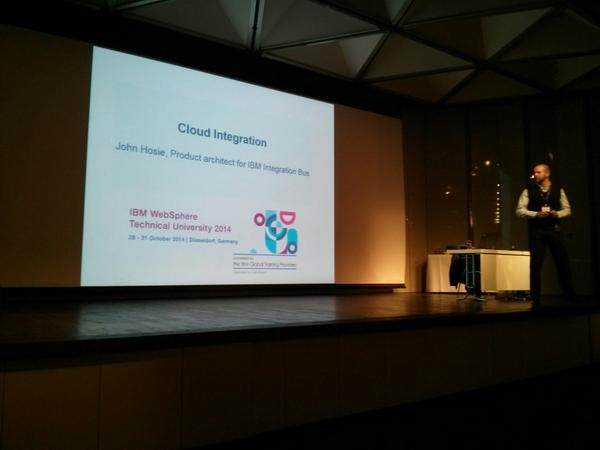
(Photo: Twitter @bluemonki)
In the session about Cloud Integration by John Hosie, he mentioned ‘Chef’, which is a tool to automate the setup and maintenance of your infrastructure in the cloud. Check https://www.getchef.com/chef/ if you want to know more.
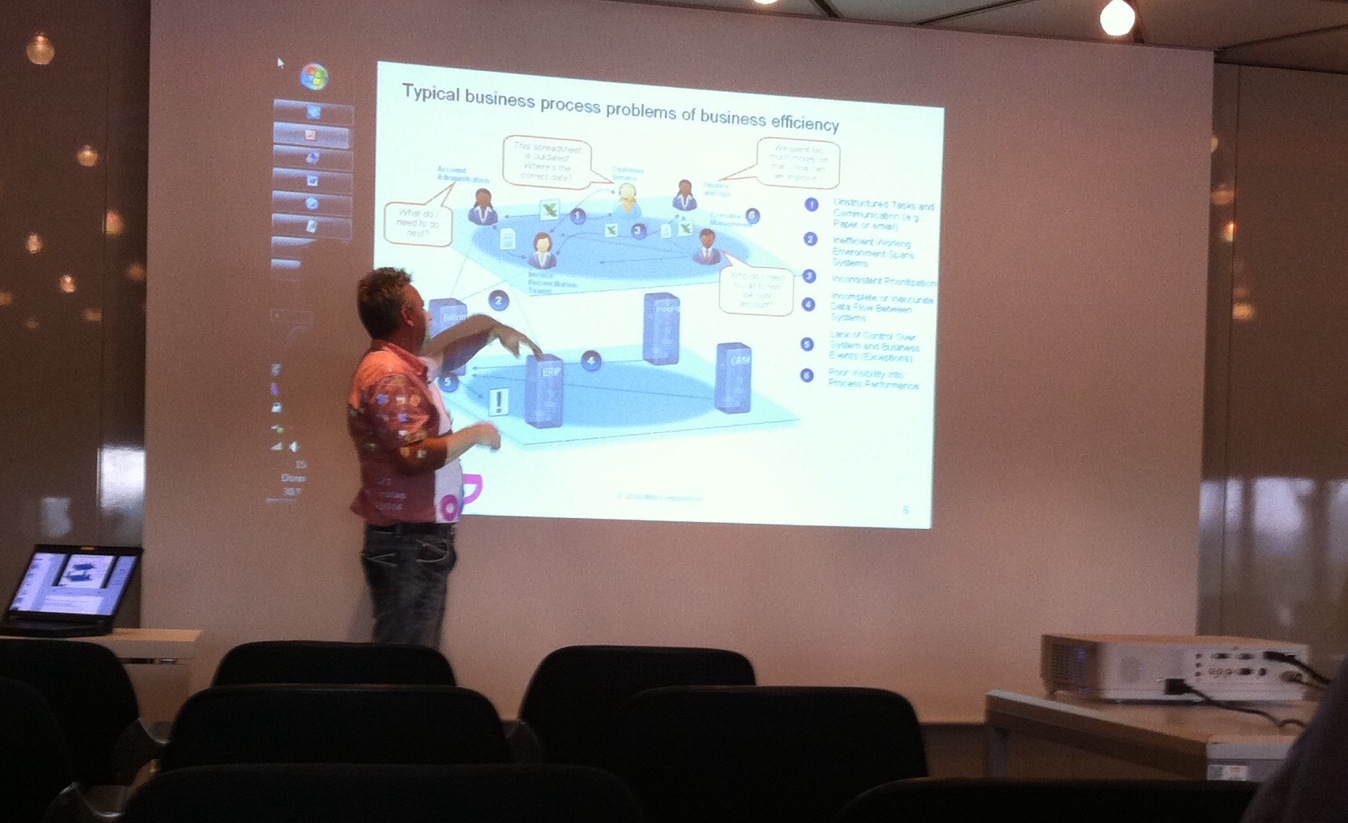
Of course something that came up in half of the sessions I attended is IBM’s answer to Platform as a Service (PaaS): Bluemix. One of the more impressive examples came from the same ‘Cloud Integration’ session. After syncing your local database with a cloud DB in Bluemix you can generate REST-API’s to retrieve the data you want to expose in just a few clicks.
Another hot topic on the conference was discussed by Bernard Kufluk and Bryan Boyd in their presentation about the Internet of Things (previously known as Smarter Planet). He gave us a glimpse of what the future might look like when all of our stuff is connected to the internet using the MQTT protocol. In contrast to most of the existing applications that nowadays use HTTP to send data to the server, MQTT makes it possible to send commands from the server to the client application (for example to stop a car remotely as shown in the demo). The appliance to take care of all this MQTT traffic is IBM MessageSight. My first impression is that this appliance is for bidirectional MQTT traffic what Datapower is for HTTP traffic.
The session about Blueworks Live from Roland Peisl presented another product that I likely won’t be working with in the near future, but nevertheless it was interesting to see how the product evolved since the last time I used it, back in the days when it was called Lombardi Blueprint. While obviously a lot has changed since then, the conclusion remains the same: it’s a great tool for the business to help them with process discovery sessions. If you’re looking for a tool that supports a full business process round-trip, you should rather use Business Process Manager.
Author: Tim
Wednesday, October 29, 2014
Websphere Technical University Düsseldorf 2014 - First impressions
Impressions of the first day of the Websphere Technical University 2014 in Düsseldorf
The Websphere Technical University and Digital Experience conference is held in Düsseldorf from the 28th of october till the 31st. With over 16 rooms for each timeslot there is something to each person’s liking. My main interest for this conference is the integration track and even though this limits the immense choice of presentations, there are still some hard choices to be made.
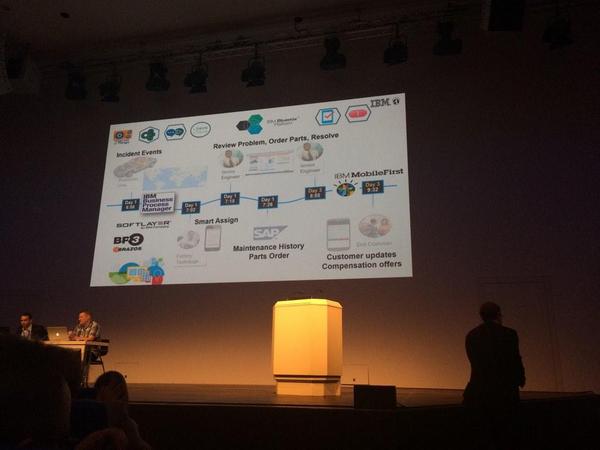
For this first day I started the day with the general opening session. This featured a great demo that showed the power of Bluemix.
(Photo: Twitter @reynoutvab)
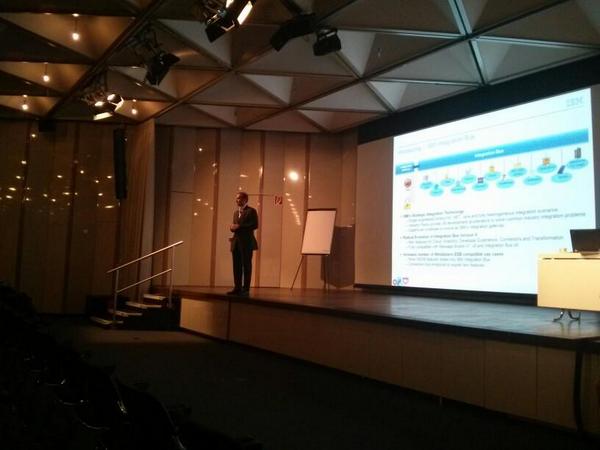
In the afternoon the conference really started for me with a presentation about the trends and directions of the IBM Integration Bus. Speaker Jens Diedrichsen (@JensDiedrichsen) introduced us the new features that will be present in IIB V 10.0
(Photo: Twitter @bluemonki)
Personal highlights for me were:
- smaller install base (download size < 1GB)
- MQ is no longer a prerequisite. Not all IIB options will work without MQ yet, but in the future this is the goal.
- Unit testing is improved with a built-in testservice and CI capabilities
- Github will be provide extra samples, best practices and also connectors.
The IIB V10.0 Open Beta is now available at http://ibm.biz/iibopenbeta to discover all the new features yourself.
The following interesting session that I attended was the presentation by Klaus Bonnert about API management. In an existing Datapower environment, the API-management software can add some useful advantages without having to rewrite your API’s:
- Analytics view
- API manager can become your single console for all deployments
- Self service for user creation
DFDL
My last session for the day was the session about DFDL (Data Format Description Language) by Alex Wood. Despite being present in MessageBroker since V8, I never really looked at it until now. Much like XSD is for XML, DFDL is a way to describe flatfile and binary data. It is a standard owned by OGF (https://www.ogf.org) and is the way to go for those who want to be able to validate or serialize general text and binary data format.
Some of the features of DFDL:
- based on XML-schema (DFDL schema is valid xml)
- human readable
- high performance, since you can choose the data format that suits you best
- github for many existing schemas that describe file formats like EDIFACT
- IBM DFDL also available as an embeddable component (latest release V1.1.1)
Subscribe to:
Posts (Atom)